Wednesday, May 30, 2018

Buy Balkrishna Industries; target of Rs 1313: Edelweiss


Edelweiss' research report on Balkrishna Industries

Balkrishna Industries�� (BKT) Q4FY18 revenue jumped 25% YoY (8% ahead of estimates), driven by robust ~17% YoY volume spurt and ~7% YoY realisation surge. Growth was well spread across segments/geographies. For FY18, volume grew ~16% YoY to ~199,200MT, ~2-8% higher than management��s guidance of 185-195,000MT. For FY19, BKT has guided volume of ~220,000MT (up 10% YoY over FY18).

Outlook

BKT is well poised to take advantage of the uptick in global industry, capitalising on its cost leadership and surplus capacity. We estimate 25% PAT CAGR over FY18-20 and maintain ��BUY�� with TP of INR1,313� . At CMP, the stock trades at 17.8x FY20E EPS.

For all recommendations report,�click here

Disclaimer:�The views and investment tips expressed by investment experts/broking houses/rating agencies on moneycontrol.com are their own, and not that of the website or its management. Moneycontrol.com advises users to check with certified experts before taking any investment decisions.

Read More First Published on May 29, 2018 06:10 pm

Tuesday, May 29, 2018

Liquidity Services (LQDT) Receives Daily Media Sentiment Rating of 0.14

Press coverage about Liquidity Services (NASDAQ:LQDT) has been trending somewhat positive recently, according to Accern. The research group rates the sentiment of news coverage by reviewing more than 20 million news and blog sources in real-time. Accern ranks coverage of public companies on a scale of negative one to positive one, with scores closest to one being the most favorable. Liquidity Services earned a daily sentiment score of 0.14 on Accern’s scale. Accern also assigned news coverage about the business services provider an impact score of 46.5172522637305 out of 100, indicating that recent news coverage is somewhat unlikely to have an impact on the stock’s share price in the near term.

Several research analysts have commented on the stock. Zacks Investment Research upgraded shares of Liquidity Services from a “hold” rating to a “buy” rating and set a $8.00 price objective for the company in a research report on Wednesday, March 14th. ValuEngine downgraded shares of Liquidity Services from a “sell” rating to a “strong sell” rating in a research report on Thursday, February 8th. Finally, Barrington Research set a $10.00 price target on shares of Liquidity Services and gave the stock a “buy” rating in a report on Tuesday, May 1st.

Get Liquidity Services alerts:

Shares of Liquidity Services traded down $0.05, hitting $5.60, during trading on Monday, MarketBeat Ratings reports. 52,649 shares of the company were exchanged, compared to its average volume of 75,781. Liquidity Services has a 1-year low of $4.34 and a 1-year high of $7.65. The company has a market capitalization of $179.77 million, a PE ratio of -5.71 and a beta of 0.60.

Liquidity Services (NASDAQ:LQDT) last announced its earnings results on Thursday, May 3rd. The business services provider reported ($0.12) earnings per share (EPS) for the quarter, topping the consensus estimate of ($0.14) by $0.02. Liquidity Services had a negative net margin of 12.72% and a negative return on equity of 19.31%. The company had revenue of $43.10 million for the quarter, compared to analysts’ expectations of $60.16 million. sell-side analysts expect that Liquidity Services will post -0.71 earnings per share for the current fiscal year.

In other Liquidity Services news, insider Roger Gravley sold 12,385 shares of Liquidity Services stock in a transaction on Monday, April 2nd. The shares were sold at an average price of $6.23, for a total transaction of $77,158.55. The sale was disclosed in a legal filing with the SEC, which is accessible through the SEC website. Insiders own 22.10% of the company’s stock.

Liquidity Services Company Profile

Liquidity Services, Inc provides e-commerce marketplace solutions to manage, value, and sell inventory and equipment for business and government clients in the United States. The company's marketplaces include liquidation.com that enable corporations to sell surplus and salvage consumer goods and capital assets; govliquidation.com, which enables federal government agencies and commercial businesses to sell surplus and scrap assets; govdeals.com that enables local and state government entities, school boards, and public utilities to sell surplus and salvage assets; auctiondeals.com self-service solution which enable sellers list their assets to commercial businesses to sell surplus and salvage assets.

Insider Buying and Selling by Quarter for Liquidity Services (NASDAQ:LQDT)

Monday, May 28, 2018

Starbucks (SBUX) Shares Bought by Gabelli Funds LLC

Gabelli Funds LLC raised its holdings in Starbucks (NASDAQ:SBUX) by 33.6% in the first quarter, according to its most recent 13F filing with the Securities and Exchange Commission. The fund owned 433,317 shares of the coffee company’s stock after acquiring an additional 109,000 shares during the quarter. Gabelli Funds LLC’s holdings in Starbucks were worth $25,085,000 as of its most recent filing with the Securities and Exchange Commission.

A number of other hedge funds and other institutional investors have also modified their holdings of the business. Magellan Asset Management Ltd lifted its stake in Starbucks by 18.1% during the fourth quarter. Magellan Asset Management Ltd now owns 30,912,781 shares of the coffee company’s stock valued at $1,775,321,000 after buying an additional 4,744,675 shares in the last quarter. Capital International Investors lifted its stake in Starbucks by 28.3% during the third quarter. Capital International Investors now owns 21,269,515 shares of the coffee company’s stock valued at $1,142,386,000 after buying an additional 4,696,452 shares in the last quarter. Harding Loevner LP purchased a new stake in Starbucks during the third quarter valued at about $128,044,000. Lazard Asset Management LLC lifted its stake in Starbucks by 300.6% during the fourth quarter. Lazard Asset Management LLC now owns 4,051,366 shares of the coffee company’s stock valued at $232,669,000 after buying an additional 3,040,030 shares in the last quarter. Finally, Atlantic Trust Group LLC lifted its stake in Starbucks by 1,244.8% during the third quarter. Atlantic Trust Group LLC now owns 2,440,293 shares of the coffee company’s stock valued at $131,068,000 after buying an additional 2,258,828 shares in the last quarter. 72.38% of the stock is owned by institutional investors.

Get Starbucks alerts:

In related news, Director Craig Weatherup sold 59,838 shares of the stock in a transaction that occurred on Tuesday, March 13th. The stock was sold at an average price of $60.10, for a total value of $3,596,263.80. Following the transaction, the director now owns 26,500 shares in the company, valued at $1,592,650. The transaction was disclosed in a filing with the Securities & Exchange Commission, which is available at this link. Corporate insiders own 3.40% of the company’s stock.

Starbucks opened at $57.92 on Friday, Marketbeat reports. Starbucks has a 52 week low of $52.58 and a 52 week high of $64.87. The company has a market capitalization of $79.60 billion, a P/E ratio of 28.12, a PEG ratio of 1.66 and a beta of 0.63. The company has a debt-to-equity ratio of 1.31, a quick ratio of 0.83 and a current ratio of 1.09.

Starbucks (NASDAQ:SBUX) last released its quarterly earnings data on Thursday, April 26th. The coffee company reported $0.53 EPS for the quarter, hitting analysts’ consensus estimates of $0.53. Starbucks had a return on equity of 60.33% and a net margin of 18.71%. The firm had revenue of $6.03 billion for the quarter, compared to the consensus estimate of $5.93 billion. During the same quarter in the prior year, the company posted $0.45 earnings per share. The firm’s revenue was up 13.9% on a year-over-year basis. sell-side analysts anticipate that Starbucks will post 2.49 EPS for the current year.

Starbucks declared that its Board of Directors has approved a stock repurchase plan on Thursday, April 26th that authorizes the company to buyback 0 outstanding shares. This buyback authorization authorizes the coffee company to reacquire shares of its stock through open market purchases. Stock buyback plans are usually an indication that the company’s leadership believes its stock is undervalued.

The company also recently disclosed a quarterly dividend, which was paid on Friday, May 25th. Investors of record on Thursday, May 10th were issued a $0.30 dividend. The ex-dividend date of this dividend was Wednesday, May 9th. This represents a $1.20 dividend on an annualized basis and a yield of 2.07%. Starbucks’s dividend payout ratio is currently 58.25%.

A number of analysts have commented on SBUX shares. Zacks Investment Research raised shares of Starbucks from a “hold” rating to a “buy” rating and set a $65.00 price objective for the company in a research note on Tuesday, January 30th. Vetr lowered shares of Starbucks from a “strong-buy” rating to a “buy” rating and set a $62.03 price objective for the company. in a research note on Wednesday, February 14th. UBS set a $64.00 price objective on shares of Starbucks and gave the company a “buy” rating in a research note on Friday, March 9th. Finally, BidaskClub raised shares of Starbucks from a “hold” rating to a “buy” rating in a research note on Friday, March 30th. One equities research analyst has rated the stock with a sell rating, thirteen have issued a hold rating and nineteen have issued a buy rating to the company. The company presently has an average rating of “Buy” and an average price target of $64.23.

About Starbucks

Starbucks Corporation, together with its subsidiaries, operates as a roaster, marketer, and retailer of specialty coffee worldwide. The company operates in four segments: Americas; China/Asia Pacific; Europe, Middle East, and Africa; and Channel Development. Its stores offer coffee and tea beverages, roasted whole bean and ground coffees, single-serve and ready-to-drink coffee and tea products, and food and snacks; and various food products, such as pastries, breakfast sandwiches, and lunch items.

Institutional Ownership by Quarter for Starbucks (NASDAQ:SBUX)

Sunday, May 27, 2018

Apple: All Margins Aren't Equal

My previous research placed the services business as a prime catalyst and reason for supporting the $100 billion share buyback plan of Apple (AAPL). Morgan Stanley upped their price target to $214 on optimism for this divisions growth as the margins on the business could provide a boost to profits that go far beyond the revenue contribution.

Source: Apple website

Services Growth

As Apple reaches for a market valuation of $1 trillion, a lot of fears exist that iPhone sales have peaked. The tech giant is getting more per phone via a higher average selling price or ASP, but Apple saw units sold peak back in 2015.

The quarterly peak was 78 million units sold back in FQ1'17, but the company has seen limited growth since FQ1'15 when 74 million units were sold. The annual units sold did peak in 2015 at 231 million units and dipped to 217 million units last year.
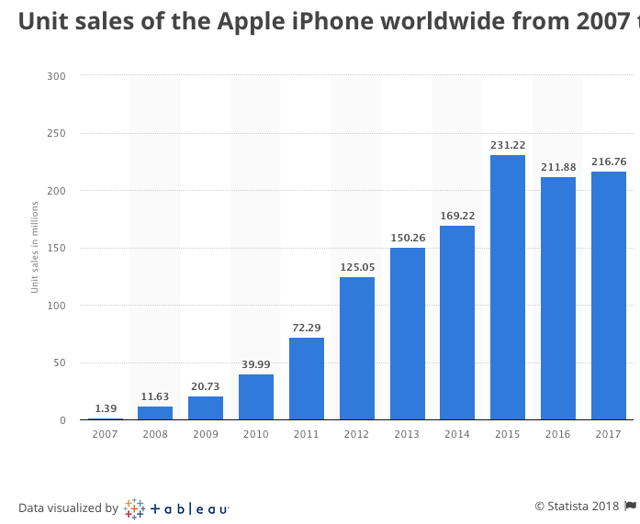
Source: Statista

While worldwide smartphone sales are forecast to continue growing with the spread of high-speed internet access around the world, the amount of consumers able to afford an $700+ iPhone isn't expected to expand materially. For this reason, Apple has spent the last couple of years trying to increase the ASP with phones like the iPhone X with a listed price above $1,000.

In the quarter ended March with a full quarter of iPhone X sales, iPhone revenues grew far in excess of units sold. The ASP grew to $734, up from $655. For this reason, iPhone revenues surged 14% on a meager 3% growth in units.
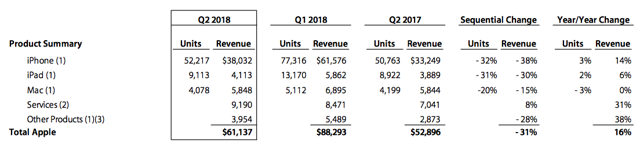
Source: Apple FQ1'18 data summary

The fears exist that Apple won't be able to continue expanding ASPs requiring a future catalyst beyond hardware. While possibly not even true, the key for investors is that the tech giant already has a business unit that has evolved into a massive division. Since the start of 2014, Services have grown revenues from under $5 billion per quarter to over $9 billion in most recent quarter. Even better, the growth is steady unlike hardware sales that require new products every year.
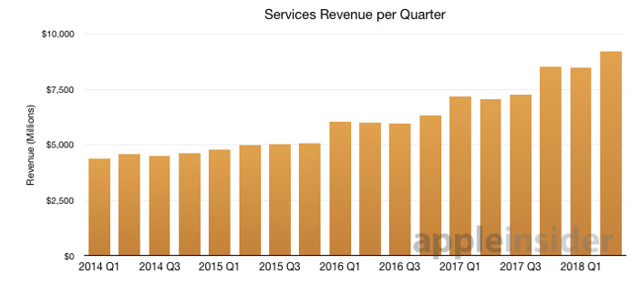
Source: appleinsider

Even better, the growth is steady unlike hardware sales that require new products every year.

Accretive Margins

The thesis for Morgan Stanley analyst Katy Huberty hiking the Apple price target to $214 from $200 is the strong margins from services. The company doesn't provide a lot of details other than the knowledge that gross margins have averaged around 39% over the lat 5 years.
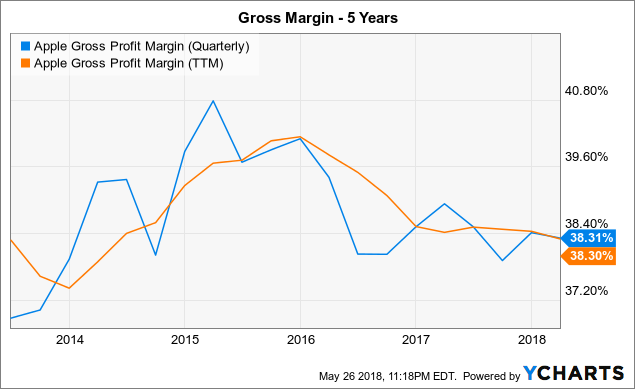
Chart AAPL Gross Profit Margin (Quarterly) data by YCharts

Historically, services generate higher margins from the recurring revenues versus selling one unit every few years. The company though has several service businesses from the App store to Apple Music. The recent IPO of streaming music service Spotify (SPOT) brought some attention to the low margins in that unit that were probably extrapolated far too much in the case of Apple.

Spotify only forecasts generating margins in the 25% range this quarter so obviously this figure is far below the corporate level of Apple and the tech giant has fewer subscribers than Spotify. Investors looking at the historical margins of Spotify might extrapolate those to the rest of the services business.
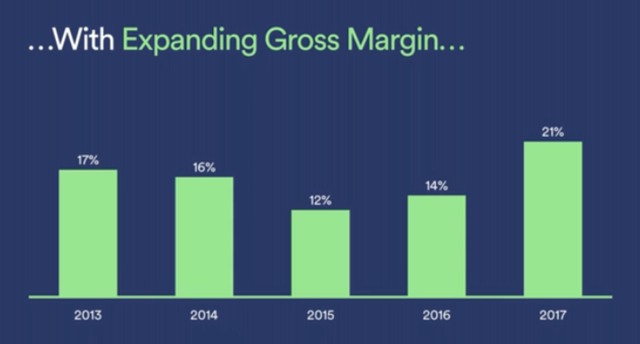
Source: Spotify Investor Day 2018

Katy Huberty projects that the services division actually generates a 50% gross margin with operating margins above 40%. Growth in services will help drive higher margins in the overall business.

Apple CFO Luca Maestri made claims on the recent FQ2 earnings call that the division does generate higher margins than the corporate average currently in the 38.5% range:

Gross margin was 38.3%, essentially flat sequentially, as we offset the seasonal loss of leverage with cost improvements and a shift in mix toward services...Our services business, and I've said it in the past, is accretive to company margins. And so as we are able to grow the services business, that should provide a positive, a tailwind.

Hubert believes services will grow from 22% of gross profit dollars in FY18 to 40% of gross profit dollars by FY22. Just keeping the remaining business flat, Apple would see a $20 billion boost to gross profits.

Combined with a $100 billion share buyback that reduces share counts by over 10%, Apple will still see a big EPS boost even if the hardware business flat lines. Based on operating margins that reach 45% and the 15% tax rate, the EPS would see about a $1 per share jump each year from services gross profit growth of about $5 billion annually. By FY22, EPS could expand $4 from growth in services alone.

The impact might turn larger if Apple reduces the share count beyond 10%. The current buyback would cut shares outstanding from 5.07 billion to closer to 4.50 billion shares, but the tech giant will generate close to $60 billion in free cash flow annually that can keep the buyback going each year.

Takeaway

The key investor takeaway is that Apple is shifting away from a reliance on the iPhone business. The highly profitable services business could easily approach 50% of profits in the next five years far before reaching the scale of the iPhone.

All margins aren't equal and this fact will benefit Apple shareholders over the next few years while the market wrongly focus on peak iPhone sales. The stock trades far too cheap at 14x FY19 EPS estimates for a business that could approach 50% of profits from services by FY22.

Disclosure: I am/we are long AAPL.

I wrote this article myself, and it expresses my own opinions. I am not receiving compensation for it (other than from Seeking Alpha). I have no business relationship with any company whose stock is mentioned in this article.

Additional disclosure: The information contained herein is for informational purposes only. Nothing in this article should be taken as a solicitation to purchase or sell securities. Before buying or selling any stock you should do your own research and reach your own conclusion or consult a financial advisor. Investing includes risks, including loss of principal.

Friday, May 25, 2018

Investment Analysts’ Weekly Ratings Updates for Rhoen Klinikum (RHK)

Rhoen Klinikum (ETR: RHK) has recently received a number of price target changes and ratings updates:

5/14/2018 – Rhoen Klinikum was given a new €29.15 ($34.70) price target on by analysts at Berenberg Bank. They now have a “neutral” rating on the stock. 5/8/2018 – Rhoen Klinikum was given a new €29.00 ($34.52) price target on by analysts at Independent Research GmbH. They now have a “neutral” rating on the stock. 5/4/2018 – Rhoen Klinikum was given a new €22.00 ($26.19) price target on by analysts at Kepler Capital Markets. They now have a “sell” rating on the stock. 5/4/2018 – Rhoen Klinikum was given a new €25.20 ($30.00) price target on by analysts at Warburg Research. They now have a “neutral” rating on the stock. 4/4/2018 – Rhoen Klinikum was given a new €25.20 ($30.00) price target on by analysts at Warburg Research. They now have a “neutral” rating on the stock. 4/3/2018 – Rhoen Klinikum was given a new €29.00 ($34.52) price target on by analysts at Independent Research GmbH. They now have a “neutral” rating on the stock. 3/29/2018 – Rhoen Klinikum was given a new €25.20 ($30.00) price target on by analysts at Warburg Research. They now have a “neutral” rating on the stock.

Shares of Rhoen Klinikum stock opened at €26.60 ($31.67) on Friday. Rhoen Klinikum AG has a 1-year low of €25.08 ($29.86) and a 1-year high of €32.12 ($38.24).

RH�N-KLINIKUM Aktiengesellschaft, together with its subsidiaries, builds, acquires, and operates primarily acute-care hospitals in Germany. Its hospitals offer treatment services primarily in the areas of cardiovascular, neurological disorders, oncology, pneumology, orthopedic, accident, and surgeries; rehabilitation and nursing services to the elderly; and thoracic, tumors, and psychosomatic, as well as spinal, column, and joints diseases.

Tuesday, May 22, 2018

Are Boomers Ready To Make The Greatest Wealth Transfer In History?

&l;strong&g;By&a;nbsp;Jess Stonefield, &l;a href=&q;http://nextavenue.org&q; target=&q;_blank&q; rel=&q;noopener noreferrer&q; target=&q;_blank&q;&g;Next Avenue&l;/a&g; Contributor&l;/strong&g;

&l;img class=&q;dam-image shutterstock size-large wp-image-1094924144&q; src=&q;https://specials-images.forbesimg.com/dam/imageserve/1094924144/960x0.jpg?fit=scale&q; data-height=&q;720&q; data-width=&q;960&q;&g;&l;em&g;Credit: Shutterstock&l;/em&g;

As we build families and age, the discussion of wills and estate plans becomes increasingly prevalent. Our financial planners (and children) want to make sure our assets go where we hope when we pass away &a;mdash; that nothing ends up in probate and that our money and valuables will be transferred seamlessly to those we love.

The only problem: no one talks about what happens &l;em&g;after&l;/em&g;.&a;nbsp; Why does it matter? Here&a;rsquo;s why: We are at the brink of the largest intergenerational wealth transfer in history.

&l;strong&g;A $30 Trillion Wealth Transfer&l;/strong&g;

Accenture reports that over the next 30 to 40 years, $30 trillion in assets will pass from boomers to their heirs in the United States alone. What many people don&a;rsquo;t realize, however, is that &l;a href=&q;https://www.forbes.com/sites/carolynrosenblatt/2011/12/09/wealth-transfers-how-to-reverse-the-70-failure-rate/#38de6bb52879&q; target=&q;_blank&q; rel=&q;noopener noreferrer&q;&g;70% of those intergenerational wealth transfers will fail&l;/a&g; by the time they reach the second generation, according to The Williams Group, a financial advisory firm. Another study found that &l;a href=&q;http://www.marketwatch.com/story/one-in-three-americans-who-get-an-inheritance-blow-it-2015-09-03&q; target=&q;_blank&q; rel=&q;noopener noreferrer&q; target=&q;_blank&q;&g;one third of people&l;/a&g; who received an inheritance had &l;em&g;negative savings&l;/em&g; within two years of the event.

&l;strong&g;Also on Forbes:&l;/strong&g;

There must be a better way.

&l;!--nextpage--&g;

Many of those inheriting money are ill-prepared to manage it. A sudden windfall is often a huge temptation to spend and splurge, rather than an opportunity to make smart financial decisions. Without proper planning, the inheritance you pass on could easily dissolve, rather than providing your children and grandchildren with a solid financial future.

&l;strong&g;3 Ways to Pass on Values and Money&l;/strong&g;

Luckily, you &l;em&g;can&l;/em&g; turn the tide of failed wealth transfer. Here are three ways:

&l;strong&g;1. Make wealth a family discussion. &l;/strong&g;Don&a;rsquo;t wait until end-of-life to discuss what wealth means to you with your children and grandchildren. Let them know why financial security matters and how you would like them to use your money when you pass away. Yes, you might want them to take a family vacation to create special memories. But you might also want them to finish college, set up a retirement account or establish a foundation for a cause you love. They won&a;rsquo;t know until you talk about it.

&l;strong&g;2. Focus on values &a;mdash; not balances. &l;/strong&g;Many kids and grandchildren discuss how much they&a;rsquo;ll get when someone in their family makes their transition. Instead of talking to your kids and grandkids about net worth, try talking to them about values. Forget &l;em&g;your&l;/em&g; legacy &a;mdash; what is your &l;em&g;family&a;rsquo;s&l;/em&g; legacy? Do you want to instill the concept of giving to those in need? How about saving animals or serving refugees? When children grow up living certain values, they are far more likely to live them when you&a;rsquo;re gone.

&l;strong&g;3. Establish a clear purpose for your wealth. &l;/strong&g;You&a;rsquo;re allowed. After all, you earned it. If you want your kids to use your wealth to launch a foundation, pay for their own child&a;rsquo;s college or provide the down payment on a new home, let them know. Stipulate that those funds must be used as intended so they won&a;rsquo;t go to waste. If you want a minimum of 50% of your wealth to be put toward a retirement nest egg or invested to launch a long-term scholarship fund for those in need, say it! Your children will likely thank you in the long run.

No matter how much or how little you are leaving to your children, it&a;rsquo;s imperative that you take steps to keep that wealth safe. Money isn&a;rsquo;t just for spending. It&a;rsquo;s for building brighter futures, more secure retirements and safe living conditions. It&a;rsquo;s for making a difference &a;mdash; and with your help, it can.

Sunday, May 20, 2018

ECB Watches Italy, German Factories, China Doubt: Eco Day

Good morning Americas. Here’s news from Bloomberg Economics to round off your week.

European Central Bank Vice President Vitor Constancio said policy makers are watching widening Italian bond spreads as populist parties inch closer to forming a government.Meanwhile, Stephanie Flanders suggests Italy’s new populist leadership could do with some lessons on debtA report Friday showed the backlog of work that factories in Germany have accumulated is enough to keep them humming for more than five months, longer still for producers of basic and intermediate goodsThe synchronized global upswing may be out of sync, according to Bloomberg Opinion’s Daniel MossMillions of Britons are trapped in low pay, according to a U.K. think tankChina has cast doubt on reports that it had offered to reduce its annual trade surplus with the U.S. by $200 billion through increased imports of American productsThe likely next head of Finland’s central bank said “the jury is still out” on whether the euro-area economy will rebound from its recent soft patchFinally, here’s our weekly wrap of what’s going on in the world economy